Why Amman Restaurants Adopt Technology Differently
A restaurant in Abdali and one in Jabal Amman can be separated by a short drive, yet their order flow, printer setup and delivery routines can look very different. Rent, customer habits, channel mix and the time available during service shape what an owner can change.
Nexara is a restaurant order and operations platform built in Amman, Jordan, with live deployments in Jordan today. It brings phone, website, QR, Talabat and Careem orders into one board, prints Arabic kitchen tickets, and gives the restaurant a commission-free own channel. The limit is that it sits beside the till. Start by testing one repeated handoff during a busy shift.
Figures in this post are illustrative examples, not a client's actual results.
What actually differs between two Amman restaurants?
Neighbourhood labels explain less than operating conditions. A restaurant near Abdali may serve office workers who order from a website during lunch. A small Jabal Amman kitchen may depend on walk-ins, phone calls and delivery platforms. Each model creates different pressure on the owner.
| Operating question | Restaurant with a digital routine | Restaurant with a manual routine |
|---|---|---|
| Where do orders arrive? | One board for website, phone, QR, Talabat and Careem orders | Staff copy orders from several phones or apps |
| How does the kitchen receive them? | Arabic or bilingual tickets print to the right printer | A cashier writes, forwards or repeats the order verbally |
| Who owns the customer? | The restaurant can collect customer records through its own channel | The restaurant mainly sees the platform order in front of it |
| How are changes made? | The menu is updated from one catalogue | Prices and availability are changed in several places |
The difference is visible at 1:00 pm. In one branch, a phone order can show the caller's saved addresses and past orders. In another, the employee asks for the address again while a delivery-platform notification waits on a different device. The handoff between order and kitchen is the practical gap.
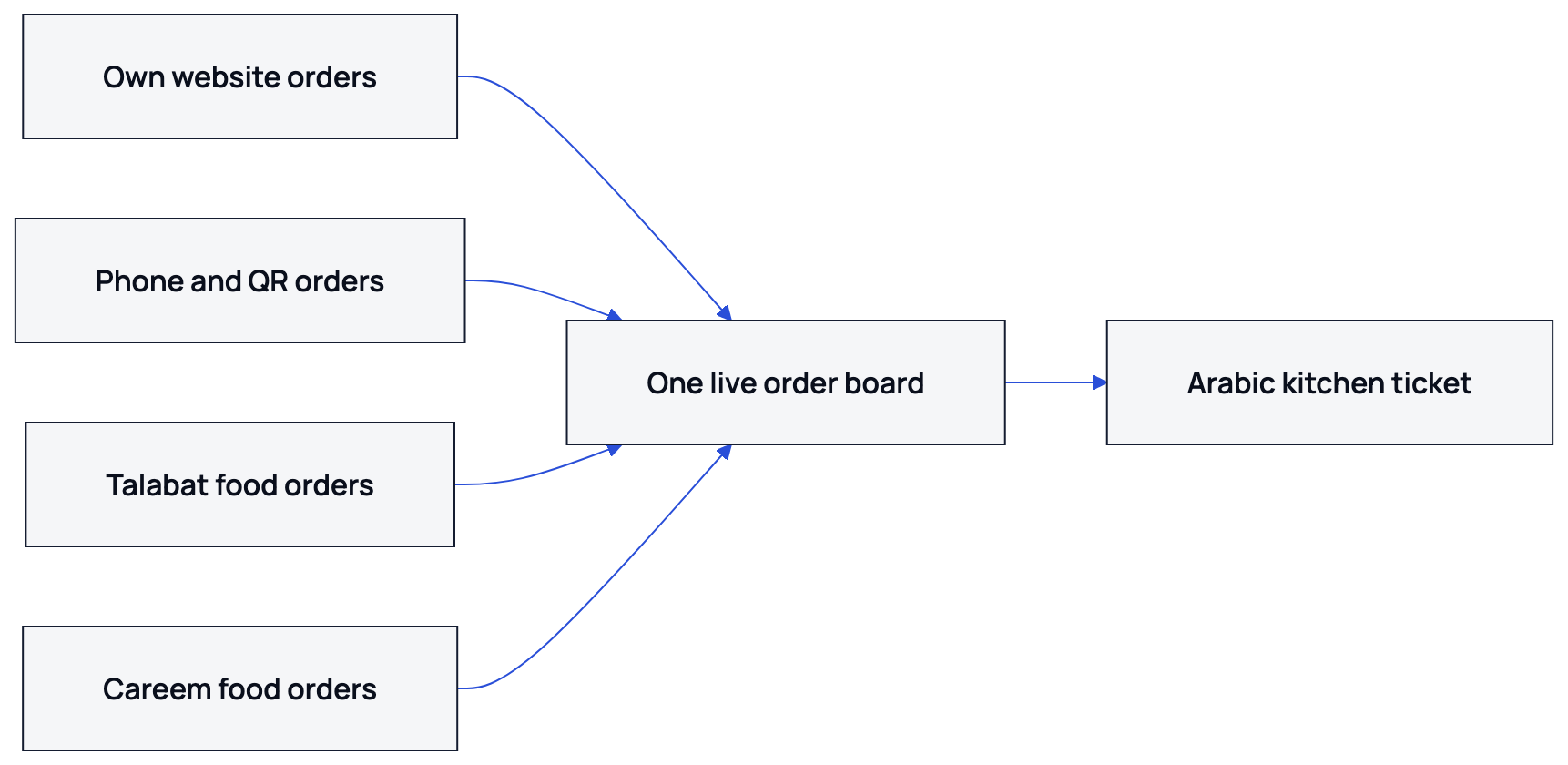
Nexara is built in Amman for this Jordanian reality. Its order board accepts phone, website, app, table QR, Talabat and Careem orders. Its printing supports ESC/POS thermal printers, with Arabic and English on the same ticket. The cashier records the day's net sale at close while Nexara handles the order and operations layer beside the till.
Why does the gap persist?
The first barrier is risk. A small restaurant cannot close for a week to replace its working routine. If the owner has one branch, one printer and three employees on a shift, every change must earn its place during service.
The second barrier is fragmented demand. A restaurant may receive orders from walk-ins, calls, its own website, Talabat and Careem. Separate screens and processes can make another channel feel like another task.
The third barrier is hardware. Nexara drives ESC/POS thermal printers over USB or a network. Kitchen tickets print without requiring a kitchen display screen. A printer usually works the same day when it is connected and configured.
The fourth barrier is ownership. Talabat and Careem keep their own commission on orders they bring. Nexara's own website, installable app and call-center orders carry 0% commission for the restaurant's own channel.
An illustrative pair: two restaurants one kilometre apart
Imagine two 30-seat restaurants, one near Abdali and one on the edge of Jabal Amman. Both receive 120 orders on a busy day. The first has a website, a phone-order routine and one kitchen printer. The second relies on two delivery-platform tablets, a mobile phone and handwritten notes.
| Illustrative point | Abdali example | Jabal Amman example |
|---|---|---|
| Busy-day orders | 120 | 120 |
| Own-channel orders | 30 website or phone orders | 5 phone orders |
| Order entry | One live board | Several devices and paper notes |
| Kitchen handoff | Printed Arabic ticket | Handwritten or verbally repeated ticket |
| Menu change | Updated once | Changed separately on devices |
| Main risk | Demand peaks at lunch | Errors rise when channels overlap |
The first restaurant may have adopted one routine because office lunch creates a sharp peak. The second may have postponed the change because its owner works the floor, the kitchen is small and the existing process feels familiar. The same approach can work in either neighbourhood.
A practical first target is one repeated handoff: stop copying website and phone orders into a notebook. Put those orders on one board, print the kitchen ticket and leave the cashier's end-of-day reconciliation where it is.
What should a small restaurant do first?
Start with the channel that creates the most avoidable repetition. A branch can make progress with one menu, one printer and one clearly assigned person during the first shift.
- Write down every order source used during one busy service, including calls, delivery platforms, the website, QR and walk-ins.
- Choose one failure to remove first, such as retyping phone orders, missing Arabic modifiers or changing an unavailable item in several menus.
- Check the existing thermal printer. Nexara supports ESC/POS printers over USB or a network.
- Create the menu and mark branch availability. One catalogue can serve the website, app, table QR, Talabat and Careem channels.
- Run one shift with the board and printed tickets. Keep the cashier's till process unchanged while the kitchen handoff is tested.
- Review cancelled, delayed and failed orders after service. Then decide whether to add the own website, call center, QR ordering or dispatch.
Nexara can make the ordering link available in one day. Talabat and Careem activation depends on partner approval. The free plan is available without a card. Paid plans are billed per branch in JOD, with current rates available by WhatsApp.
What does Nexara solve?
Nexara gives a restaurant one order board for phone, website, app, table QR, Talabat and Careem orders. It prints Arabic kitchen and receipt tickets, keeps customer records attached to orders, manages menu availability and provides report tabs across orders, products, customers, channels, delivery, money and operations.
The restaurant can use its own website or installable app. Delivery and pickup checkout can use cash, while online card payment is available through HyperPay when enabled. Dine-in customers can pay at the counter. Orders remain in the cloud queue while a printer catches up after reconnection; the board needs a connection.
For the full feature list, read the <a href="/features/">Nexara features</a>. For channel details, see <a href="/integrations/">Nexara integrations</a>.
How can an owner judge progress after 30 days?
Use operating evidence rather than a technology label. Check whether staff can identify the source of every order, whether the kitchen receives the full modifier list and whether menu availability matches what customers can buy.
- Count orders copied by hand during a selected service.
- Check whether Arabic item names and modifiers printed correctly.
- Review cancelled and failed orders by channel.
- Compare own-channel orders with platform orders.
- Ask the cashier whether the close matches order history.
- Record which printer or device caused a delay and fix that point.
A restaurant does not need the same routine as an Abdali office-district site. It needs one problem, one shift and one measurable handoff to improve. The owner controls that order path.
What to remember
- Technology adoption in Amman follows operating conditions more than neighbourhood labels.
- Start with one repeated handoff, such as phone or website orders reaching the kitchen without retyping.
- Nexara combines phone, website, QR, Talabat and Careem orders on one board and prints Arabic tickets on thermal printers.
- Nexara is built in Amman with live deployments in Jordan. Its own website, app and call-center orders carry 0% commission.
Questions people ask
Why do Abdali restaurants seem more digital than Jabal Amman restaurants?
Customer mix, peak hours, rent, staffing and channel demand can differ by site. A small Jabal Amman branch can adopt one useful routine without copying a larger office-district restaurant.
Can Nexara work for a small restaurant in Jabal Amman?
Yes. Nexara has a free plan and paid plans per branch in JOD. A small branch can begin with its menu, order board and existing ESC/POS printer, then add its own website, phone ordering or QR channel.
Is Nexara a POS or cash register?
Nexara is the order and operations layer beside the till. It collects orders, shows them on the board, prints kitchen tickets and supports cashier reconciliation, while the till handles cash.
Does Nexara print Arabic kitchen tickets?
Yes. Nexara prints Arabic and English tickets on ESC/POS thermal printers over USB or a network. Tickets can be routed to the appropriate kitchen printer.
Can Nexara replace Talabat and Careem?
Nexara receives Talabat and Careem orders and can send relevant status updates through their integrations. It also gives the restaurant its own website, app and call-center channel, where own orders carry 0% commission.