Case study: a bakery chain finds its waste with morning counts
At 06:00 in an Amman bakery, five missing kilograms of flour can matter more than a busy sales report. If the count comes after production, the branch is already trying to explain yesterday's waste.
Nexara is a restaurant order and operations platform built in Amman, Jordan, for restaurants and multi-branch chains. For a bakery, it turns morning counts into assigned checks for production, purchasing, waste, and branch review. Nexara is built for the Arabic-speaking Middle East, with Jordan live deployments today. This fictional case shows the method.
Figures in this post are illustrative examples, not a client's actual results.
What happened at the bakery?
Consider a fictional bakery chain in Amman with three branches. Its morning production depended on yesterday's sales, a manager's memory, and a quick look at the display shelves. Each branch had a branch manager, a baker, and a stock or purchasing lead. They were busy before 08:00, so counts were often delayed until after production.
The result was a familiar Jordanian bakery problem. One branch made extra manakeesh and croissants on a quiet morning, while another ordered flour, cheese, and paper bags without a current count. Waste sat in a notebook. Nobody compared it with the opening quantity or the day's production.
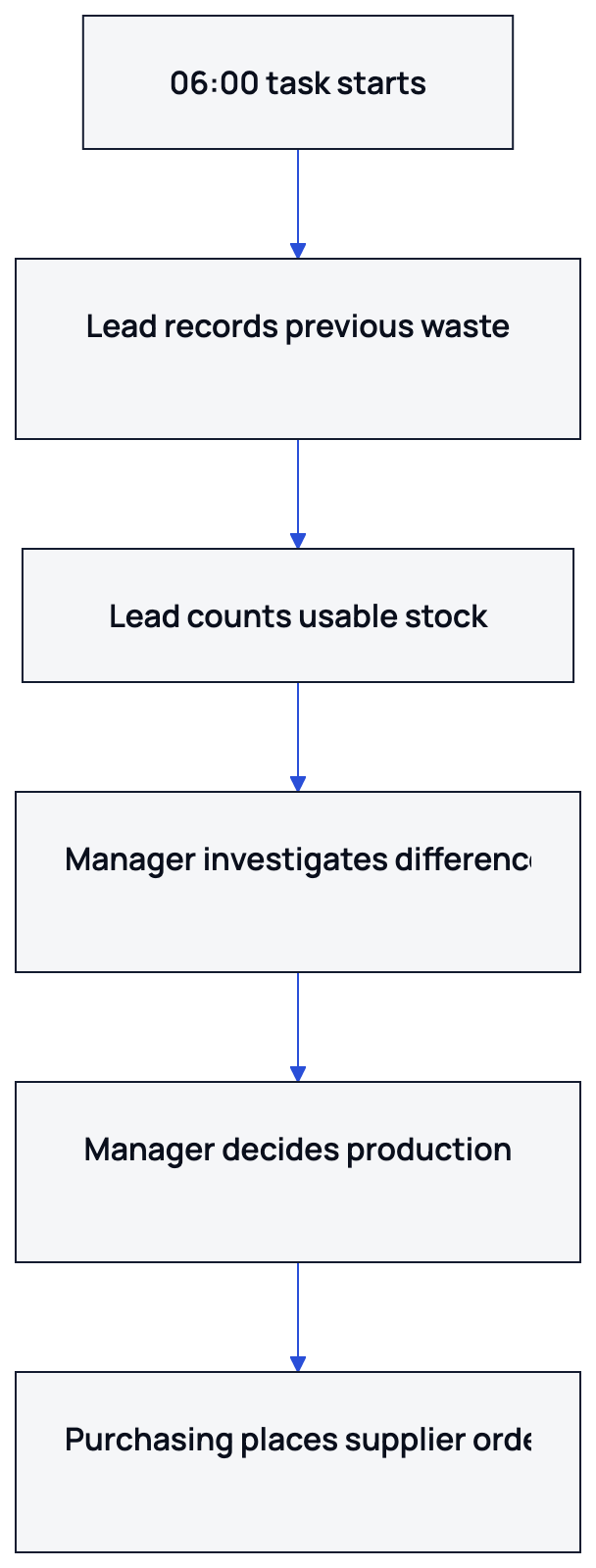
The fix was a fixed morning handoff. The baker counted finished items and key ingredients. The branch manager checked unusual differences before approving production. The purchasing lead reviewed shortages before placing an order. NexaraFlow assigned each step by role, while Nexara Inventory kept counts, recipes, waste, suppliers, and purchase orders in the same dashboard.
Which numbers exposed the problem?
The first useful report compared the expected opening quantity with the counted quantity. Each difference had an action beside it, so the manager could investigate before approving the purchase order.
| Item | Expected | Counted | Variance | Action |
|---|---|---|---|---|
| Plain croissants | 84 | 68 | -16 | Reduce first bake |
| Cheese manakeesh | 96 | 81 | -15 | Check tray waste |
| Flour | 42 kg | 37 kg | -5 kg | Review recipe usage |
| Paper bags | 620 | 548 | -72 | Add to purchase order |
These figures do not prove theft, a bad recipe, or a supplier error. They identify where the manager should look. A missing 5 kg of flour may come from a yield problem, an unrecorded transfer, a weighing mistake, or production that was never entered. The next count shows whether the cause repeats.
Finished items guide the first production run. Ingredient counts guide purchasing. Packaging counts show whether a branch can keep selling after lunch. Recording each category against its own expected quantity keeps the follow-up specific.
How did each role use NexaraFlow?
At 06:00, the inventory lead received the count task for the branch. After submission, the baker recorded the previous shift's production and waste. The manager then saw the variance and approved or changed the first bake. Purchasing reviewed the remaining stock before sending the supplier order.
- The inventory lead counted flour, sugar, cheese, fillings, packaging, and selected finished items before production.
- The baker recorded production quantities and waste from the previous shift.
- The branch manager checked unusual variances and approved the day's production quantities.
- The purchasing lead reviewed stock alerts, supplier records, and purchase orders.
- The area manager reviewed overdue tasks and repeated variance patterns across branches.
Each step had an owner, branch, and stage. The area manager could see whether a branch had completed its count instead of relying on a message from head office. NexaraFlow is a Pro-plan workflow feature.
Use the practical morning inventory count guide to choose the first items. Nexara also supports recipes, recipe costing, prep yield, stock alerts, waste analytics, and branch stock requests.
What changed in ordering and waste?
After several weeks of consistent counts, the bakery changed its ordering rule. The purchasing lead stopped relying on the previous week's average alone. The order considered the counted balance, recipe quantity, planned production, and supplier delivery day.
| Control | Before | After |
|---|---|---|
| Opening count | 0 of 5 key checks logged before 07:00 | 5 of 5 logged before 07:00 |
| First bake | Estimated from memory | Approved after 4 item checks |
| Flour order | 42 kg requested from prior average | 37 kg counted before request |
| Waste review | 1 notebook entry after shift | 3 waste entries linked to the morning review |
| Accountability | 0 named task owners | 5 role-based task owners |
The illustrative branch scale reflects Jordanian restaurant conditions: roughly 60 to 400 orders a day, with tickets often averaging 4 to 12 JOD. The useful comparison is your own opening count against production, waste, and purchasing records over several mornings.
The manager should look for repeated variance. A product short every morning needs a process check. A product repeatedly left over needs a production change. A supplier order that arrives short needs receiving records beside the count.
What should another bakery measure first?
Start with a small count list. Counting every item can make the routine slow enough to skip. Choose items that affect the first production batch, purchasing, or waste. Add more after the team completes the first list accurately.
- Count ingredients used in the first production batch.
- Count high-waste finished products before opening.
- Count packaging that can stop sales when it runs out.
- Record the unit, such as kilograms, trays, pieces, or rolls.
- Compare expected and counted quantities by branch.
- Review the same variance for 3 to 7 mornings before changing a recipe or supplier.
- Keep one owner for the count and one reviewer for approval.
The how-to morning count guide explains the operating habit. For timed ownership, see NexaraFlow timed tasks. Nexara is the order and operations layer beside the till. The cashier records the day's net sale and completes reconciliation at close.
Where does Nexara fit in a bakery chain?
Nexara gives the bakery one place to check inventory, recipes, counts, waste, suppliers, purchase orders, branch requests, and reports. The same platform receives phone, website, app, table QR, Talabat, and Careem orders on one live order board. Arabic and English kitchen and receipt tickets print on ordinary ESC/POS thermal printers. Talabat and Careem activation depends on partner approval in each market.
The bakery's own website, app, and call-center orders carry 0% commission. Talabat and Careem keep their own commissions on the orders they bring. Nexara does not provide JoFotara e-invoicing, Jahez or DHUB integrations, WhatsApp order notifications, staff scheduling, accounting connectors, or an offline cash register.
The platform is built in Amman, Jordan, and live deployments are in Jordan. Issa Al-Dalu, Nexara's founder, answers support through WhatsApp and email during Amman hours. Nexara offers a free plan, followed by paid plans per branch in Jordanian dinar. Current rates are available on request. See Nexara features, the founder's page, or book a demonstration.
What to remember
- Count before production, while the quantity can still change the first bake.
- Use variance to choose the next check, rather than assigning blame.
- Give the person counting a named owner and the approval a separate reviewer.
- Review the same item for 3 to 7 mornings before changing a recipe or supplier.
- A bakery can test the routine in one branch before applying it across the chain.
Questions people ask
How should a bakery choose its first 10 count items?
Choose ingredients used in the first production batch, products with the most waste, and packaging that can stop sales when it runs out. Add items with repeated variance after the team completes the first list consistently.
What is a good time for a bakery morning count?
Count before production and before the first purchasing decision. The exact time depends on the branch opening and supplier schedule.
How does Nexara record bakery waste?
Nexara includes inventory counts, waste analytics, recipes, suppliers, purchase orders, and costing tools. The branch records the quantity and reviews repeated variances.
Can Nexara assign the morning count to different roles?
NexaraFlow assigns recurring timed tasks by role and branch, with stages, SLA clocks, and escalation. The Morning Inventory template is one of its seeded workflows.
Does Nexara replace a bakery cash register?
Nexara handles orders, inventory, counts, printing, tasks, and reports. The cashier records the day's net sale at close and completes reconciliation.
Does Nexara support Arabic bakery tickets?
Yes. Nexara prints Arabic and English kitchen and receipt tickets on standard ESC/POS thermal printers over USB or a network.