Case study: Amman shawarma chain ends order retyping
At 21:00, taking the order is rarely the hard part. The trouble starts when someone copies it from a phone or tablet into another screen while the kitchen waits and customers call back.
For a small chain, the change is one handoff instead of repeated reading and retyping. Nexara is a restaurant order and operations platform built in Amman, Jordan, putting Talabat, Careem, phone, website, app and table QR orders on one branch board with Arabic kitchen tickets beside the till. Talabat and Careem activation needs partner approval. Start on WhatsApp.
Figures in this post are illustrative examples, not a client's actual results.
What was going wrong before one order board?
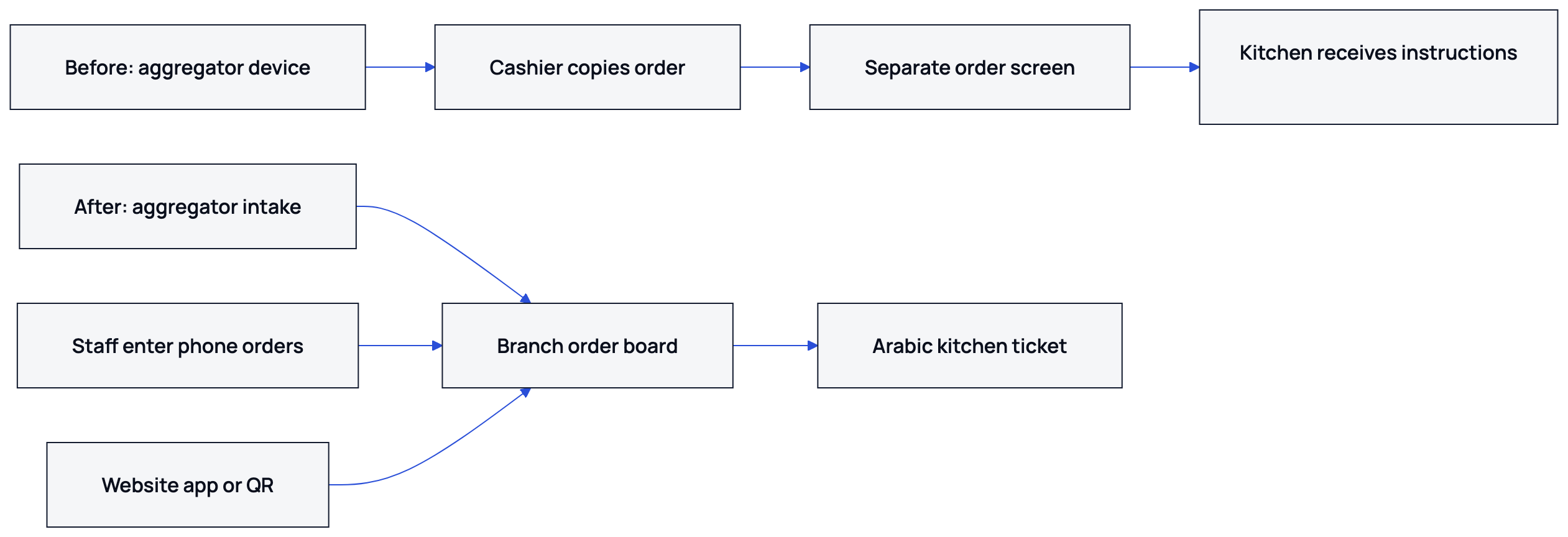
Picture a three-branch shawarma chain in west Amman. In this illustrative operating model, staff receive Talabat and Careem orders on aggregator devices, take phone orders, and manually re-enter selected orders into a separate system before telling the kitchen what to make. That assumption drives the example numbers below.
An item can change when it is read, retyped or repeated to the kitchen. A missing garlic sauce or wrong meal size can lead to a remake, a second phone call and a delayed driver.
The illustrative input is 180 orders per branch per day, with 40% arriving through Talabat or Careem, 35% by phone and 25% through the restaurant's own channels. These are operating assumptions for the example, not Nexara results.
| Before the change, illustrative input | Example |
|---|---|
| Branches | 3 in Amman |
| Orders per branch per day | 180 |
| Aggregator share | 40% |
| Phone share | 35% |
| Average retyping time | 2 minutes per order |
| Retyping mistakes | 6 orders per branch per day |
At 180 orders per branch, two minutes of manual entry on the orders that require it can consume substantial staff time. The operational measure is how many times the same order is read before the kitchen receives it.
How does Nexara put the channels together?
During a rush, the operator sees one branch board instead of checking several channel screens and repeating details for the kitchen. Call-center, website, app, table QR, Careem and Talabat orders appear in the same queue, with searchable history, filters and statuses such as pending, preparing, ready for pickup and delivered.
A phone order uses the caller's number to show saved addresses and past orders. The agent selects the items and places the order from the call-center screen, leaving the branch with a customer record it owns.
The restaurant's own website and installable app carry its branding and charge 0% commission on those own-channel orders. Talabat and Careem keep their own commissions on orders they bring. One menu can serve supported channels, with availability set by branch.
Read the guide to Talabat and Careem order intake, see how the live order board handles channel orders, and compare the operating pattern in shawarma fast-casual chains.
What changed after Nexara was introduced?
In this illustrative case, each branch connects Talabat and Careem intake after partner approval, adds its own ordering link and gives phone agents access to the call-center screen. The cashier still records the day's net sale at close. Nexara sits beside the till as the order and operations layer.
The kitchen receives printed tickets on ordinary ESC/POS thermal printers. Arabic item names and modifiers print correctly, and English can appear on the same ticket. Printer groups can separate kitchen, bar and cashier work, while category settings control which printer receives each item.
If a printer stops responding, the ticket stays on the board and waits in a queue. Staff can re-route its categories from the dashboard, or automatic failover can use a configured backup printer. Tickets queue while the branch connection is down and print when the printer answers. The board itself needs a connection.
The chain also gains branch-level menus, availability controls, customer records, order history and report tabs across orders, products, customers, channels, delivery, money and operations. Managers can compare branches without reconstructing the evening from separate screens.
What were the illustrative results?
The figures below describe the same illustrative example. They are not a Nexara customer result. The model uses 180 orders per branch per day, two minutes of manual retyping per order and six orders per branch per day containing a retyping mistake.
| Measure | Before the change, illustrative input | After the change (illustrative) |
|---|---|---|
| Orders per branch per day | 180 | 180 |
| Manual channel retyping | Used for selected channels | Removed from the shared order path |
| Retyping time | 2 minutes per order | 0 minutes for orders entering the board |
| Retyping mistakes | 6 per branch per day | 0 from that retyping step |
| Kitchen instruction | Verbal repeat plus separate entry | Printed Arabic ticket |
| Branch visibility | Separate channel screens | One live order board |
The example describes a changed handoff rather than a measured percentage improvement. Track manual entries, missing modifiers, remakes, customer callbacks and the time from order acceptance to kitchen ticket at your own branch.
Nexara has tens of thousands of orders a month through its board and dozens of branches across Jordan. Those are platform-level facts, not figures for this fictional chain.
What should you check for your own branch?
Follow five orders through one dinner service. Record the channel, each person who touches the order, re-entries, the printer used and the final status. Include a phone order, a Talabat order, a Careem order, an own-channel order and a table QR order.
- Confirm which Talabat and Careem branches can be activated and whether partner approval is required in your market.
- List every printer by branch and check that it is a standard ESC/POS thermal printer connected over USB or network.
- Record Arabic names for top modifiers, meal sizes and special instructions, then verify them on a printed ticket.
- Check who owns phone customers, addresses, order history and complaint records after completion.
- Compare plan fit: Nexara has a free plan, then paid plans per branch in Jordanian dinar. Current rates are available on request.
- Choose one branch for setup and test the order board during a real service period.
Nexara is built in Amman for restaurants and multi-branch chains. Its deployments are in Jordan, while the platform can run anywhere with a browser and the Windows print agent. Arabic and English are supported. Issa Al-Dalu answers support through WhatsApp and email on Amman hours. Start at nexaratech.io.
What to remember
- Manual retyping creates another chance for an item, modifier or address to change.
- Nexara puts Talabat, Careem, phone, website, app and table QR orders on one branch board.
- Arabic tickets print on ordinary ESC/POS thermal printers beside the till.
- Measure retyping, callbacks, mistakes and kitchen handoff time at your own branch.
- Begin with one branch and a real dinner-service test.
Questions people ask
Does Nexara replace the cashier system?
Nexara is the order and operations layer beside the till. Orders reach the live board and print in the kitchen, while the cashier records the day's net sale at close for reconciliation.
Can Talabat and Careem orders print in the kitchen?
Yes. Talabat and Careem orders can enter the branch order board and print as Arabic kitchen tickets. Activation depends on partner approval and the market.
Does the phone screen remember returning customers?
The call-center screen can look up a customer by phone and show saved addresses and past orders. The agent can place the order from that screen.
What happens if the kitchen printer stops?
The order remains on the board and the ticket waits in a queue. Staff can re-route categories from the dashboard, or automatic failover can use a configured backup printer.
Can the branch work without internet?
Orders keep arriving in the cloud queue while the connection is down, and the printer catches up when it returns. The board needs a connection, so a phone hotspot beside the printer computer is the practical backup.
Does Nexara send WhatsApp order notifications?
No. Nexara includes a WhatsApp conversation inbox for call-center roles, but it does not send WhatsApp order notifications.
How much does Nexara cost?
There is a free plan, followed by paid plans per branch in Jordanian dinar. Current rates are available by WhatsApp message, and the first payment has a 14-day money-back period.
How do I test Nexara with one branch?
Send a WhatsApp message to the founder. Discuss the branch, channels, printers and partner activation before choosing a setup.