How to log a complaint, route it, and close it with a record
A customer calls back about a missing item, and the person who promised to help has left for the day. I have stood in that kitchen at service time: without a record, the next person starts the investigation from zero.
Nexara is a restaurant order and operations platform built in Amman, Jordan, that turns a call-screen or walk-in complaint into a case with a category, branch, assignee, SLA clock, photos, escalation and resolution note. It does not provide offline complaint logging or an email intake channel. Call-center access and workflows require Pro.
How do you capture the complaint at first contact?
Nexara supports complaint logging from the call screen. An agent can look up the customer by phone and see saved addresses and past orders. Select the relevant order, record the complaint, and keep the customer’s report separate from the branch’s investigation. A missing item and a late delivery can then be followed as distinct cases.
A walk-in complaint can be recorded as a case using the same complaint information. The case supports a category, branch, assignee, SLA minutes, photos and a resolution note. That gives the responsible team a record to follow even when the complaint did not begin with a phone call.
Complaints can also emerge during follow-up. Nexara’s feedback-call tasks come from delivered orders and include item summaries. The guide to feedback calls after delivery explains that starting point.
How does Nexara put the complaint in the right hands?
Nexara complaint cases use a routing ladder and can sync to workflow tasks. Assign the case to the branch and person responsible for the next action. If the issue needs more authority or remains unfinished, mark it for higher-level handling.
Use a category that describes the reported issue, then check the assigned branch and owner. The category stays with the case as it moves through handling, so a manager can distinguish a missing food complaint from a delivery problem without reading every note first.
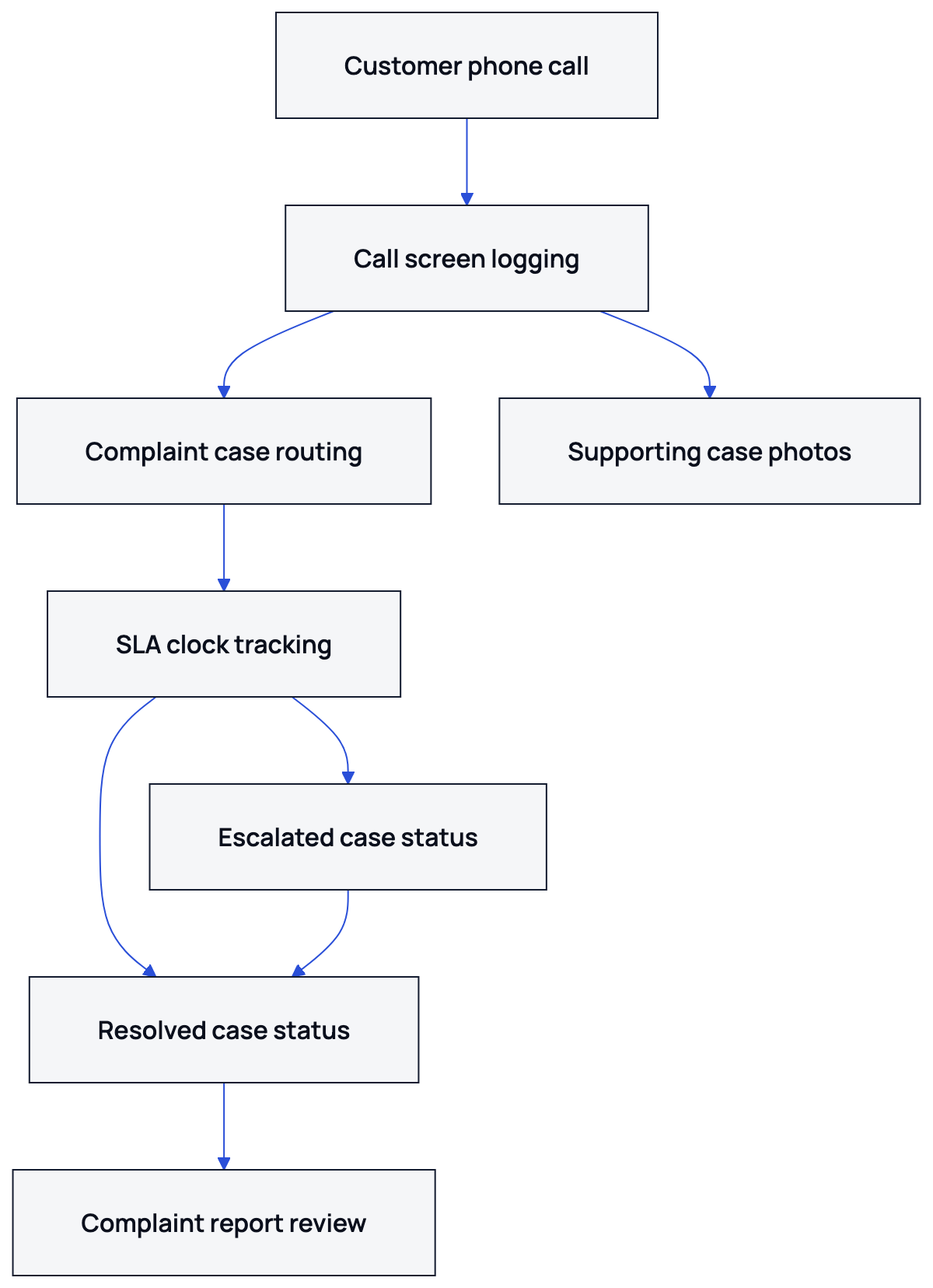
NexaraFlow has role-based task lists and branch assignments, including an Escalated Complaint template. When a complaint syncs to a workflow task, the responsible role sees the work in its task list and the manager can review its stage and SLA state. Workflows are a Pro-plan feature. See the Nexara features and Nexara integrations pages for the wider platform context.
What do the SLA clock and case labels mean?
Complaint cases support SLA minutes and display four case chips. The SLA minutes are the time target attached to handling the case. The chip shows the current case status, so staff can identify overdue or completed work from the complaint list.
| Case label | Meaning in Nexara |
|---|---|
| Open | The complaint case has not been resolved. |
| Breached | The case has passed its SLA time target without reaching resolved status. |
| Escalated | The case is receiving higher-level handling. |
| Resolved | The case has reached resolved status and contains the restaurant’s closing record. |
An escalated case retains the original complaint, its category, branch, assignee, SLA state and notes. The receiving person can see what has happened before deciding the next action. For more on timed handling, see complaint cases and SLA clocks.
What should you keep with the complaint?
Nexara complaint cases support photos. Attach an image when it records useful evidence, such as damaged packaging or the condition of food on arrival. The photo stays with the case alongside the written complaint and resolution note.
Write the customer’s report precisely. “Customer reports a missing side dish” identifies the issue. “Bad order” does not. If the branch later confirms what happened, record that finding as part of the case history rather than replacing the original report.
- Find the customer and relevant order through the customer record, including saved addresses and order history.
- Record the reported issue as a complaint case and select its category.
- Assign the case to the responsible branch and person.
- Attach a relevant photo when it supports investigation.
- Add the action taken and the outcome communicated to the customer in the resolution note.
For telephone follow-up, how to run a feedback call provides a related staff routine. The complaint record should contain enough context for another colleague to continue the case without asking the customer to repeat the first call.
When is a complaint ready to close?
Nexara includes resolved as one of the complaint case statuses. Move a case to resolved after the recorded action is complete and the customer outcome has been communicated. A promise to investigate leaves the case open. A promised replacement leaves it open until the restaurant confirms the required action is complete.
If the customer cannot be reached, keep the case open or escalate it according to the restaurant’s handling rule. The case status records whether the complaint is still open, has breached its SLA, has been escalated, or has been resolved.
How do you review complaints after closure?
Nexara includes a Complaints report tab and a separate Customer Reviews report tab. In the Complaints report, review the case status, category, branch, assignee, SLA state and resolution record. Those fields show where complaints are concentrated and which cases remain open or breached.
Compare repeated categories with the notes and photos attached to the cases. If several cases share the same category and branch, inspect the corresponding resolution records rather than relying on memory. The report keeps the review tied to cases that have a recorded owner and outcome.
Bloub can retrieve open complaints and complaint details. A manager can use those results to find outstanding cases and inspect the details recorded for a specific complaint. Decisions about recurring issues should point back to the category, branch, SLA state and resolution note in Nexara.
Nexara is built in Amman, Jordan, and support is available through WhatsApp and email during Amman hours, in Arabic or English. The founder, Issa Al-Dalu, answers support questions. Review nexaratech.io, then message him if you want help applying the process to your restaurant.
What to remember
- Log the complaint from the call screen or as a walk-in case while the customer and order context are available.
- Use the case category, branch, assignee and SLA clock to make ownership visible.
- Attach photos and a precise resolution note when they support the case record.
- Use resolved status only after the recorded action and customer outcome are complete.
- Review the Complaints report by status, category, branch, assignee and SLA state.
Questions people ask
How do complaint cases work in Nexara from first call to closure?
Staff can log a complaint from the call screen or record a walk-in complaint. The case carries a category, branch, assignee, SLA clock, photos, routing and resolution note, with open, breached, escalated and resolved labels.
Can I see a caller’s past orders before logging a complaint?
Yes. Nexara’s call center supports lookup by phone, showing saved addresses and past orders so staff can identify the order connected to the complaint.
How do I handle a complaint from a walk-in customer?
Record the walk-in report as a complaint case and add the relevant category, branch, assignee, SLA target, notes and photo when needed. The case follows the same routing and closure statuses as a complaint logged from the call screen.
Can I add photos to a Nexara complaint case?
Yes, complaint cases support photos. Attach an image that helps the person handling the case understand or investigate the reported issue.
Who can see a complaint case?
The case is assigned to a branch and responsible person, while role-based workflow task lists show work to the relevant staff. Managers can review the case stage and SLA state.
What should a restaurant write before closing a complaint?
Record the action completed and the outcome communicated to the customer. Keep that resolution note with the case, then change the case status to resolved when the stated outcome is complete.