How should a restaurant publish its menu for AI agents to read?
You changed the printed menu, but an old Instagram photo is still circulating. An assistant helping someone choose dinner may find that photo before it finds your ordering page.
Nexara publishes readable menus with item names, prices, options, availability and branch hours as text and structured data. It is a restaurant order and operations platform built in Amman, Jordan, with agent ordering built into every Nexara storefront for ACP (2026-04-17), UCP or MCP. Check your public menu, branch details and ordering path, then speak with the founder.
Why does a menu photo leave an AI assistant guessing?
A JPEG menu on Instagram holds words inside an image. The problem is whether an assistant can reliably connect each item to its current price, available options and the branch that can prepare it.
A photograph also survives the price change that made it obsolete. Someone can repost it, save it or send it in a chat. Unless the restaurant publishes a clear, current source, the assistant has to judge which version applies. A readable menu page gives it a specific place to check.
Keep food photography for showing the meal. Put names, descriptions and prices in selectable page text beside the images. Give that page a stable address, link it from your restaurant profiles, and make the ordering route visible. Opening hours should identify the relevant branch and its local time.
What information makes a menu readable and orderable?
An assistant recommending dinner needs enough information to compare dishes. An agent placing the order also needs to know which choices are required and what they cost. Write Arabic and English names for the same item, and keep portion descriptions consistent between languages.
| Menu information | What to publish | What it helps resolve |
|---|---|---|
| Item identity | Arabic and English names, category and a plain description | Which dish the customer means |
| Price and currency | Current base price with JOD clearly identified | What the item costs before selected extras |
| Modifiers | Required choices, optional extras and each price adjustment | Whether the requested combination can be ordered |
| Availability | Current availability for the selected branch | Whether that branch can accept the item |
| Branch hours | Opening and closing times by day, with local time and exceptions | Whether the requested branch is open |
| Fulfilment | Pickup or delivery path and a delivery quote before confirmation | How the customer receives the food and the final total |
A modifier named “Extra” leaves too much to interpretation. Name the ingredient or portion, show its charge, and distinguish a required size from an optional addition. If a choice changes the dish substantially, explain that where the customer selects it.
Availability belongs to the branch preparing the order. A dish being available elsewhere in the chain does not help the customer ordering from a branch that has sold out. Nexara supports modifier groups and per-branch availability; the menu modifiers and add-ons guide explains how to organise those choices.
How does schema.org Menu help an assistant understand dinner?
Structured data gives explicit labels to information on a page. In schema.org, Restaurant describes the business, Menu describes its menu, and MenuItem describes a dish. Those labels help a reader distinguish a restaurant name from an item name, and a dish description from unrelated page text.
The visible menu and its structured information should agree. A current price on the page paired with an old price in the structured data creates two competing answers. Ask whoever manages your website to check both whenever you change menu content.
Nexara storefronts publish menu text and Restaurant, Menu and MenuItem structured data with actual availability. They also provide restaurant information in Arabic and English for AI readers. The practical benefit is a menu that people can read and software can interpret using labelled information.
Structured data identifies what is offered. The ordering path must also handle the customer's choices, delivery cost and confirmation. Treat both as part of the menu's job.
Where should the menu live before an agent uses it?
Make your restaurant's ordering website the maintained source for menu information. Instagram can point customers to it. Your Google Business Profile should use the same menu destination, with the correct branch address and phone number.
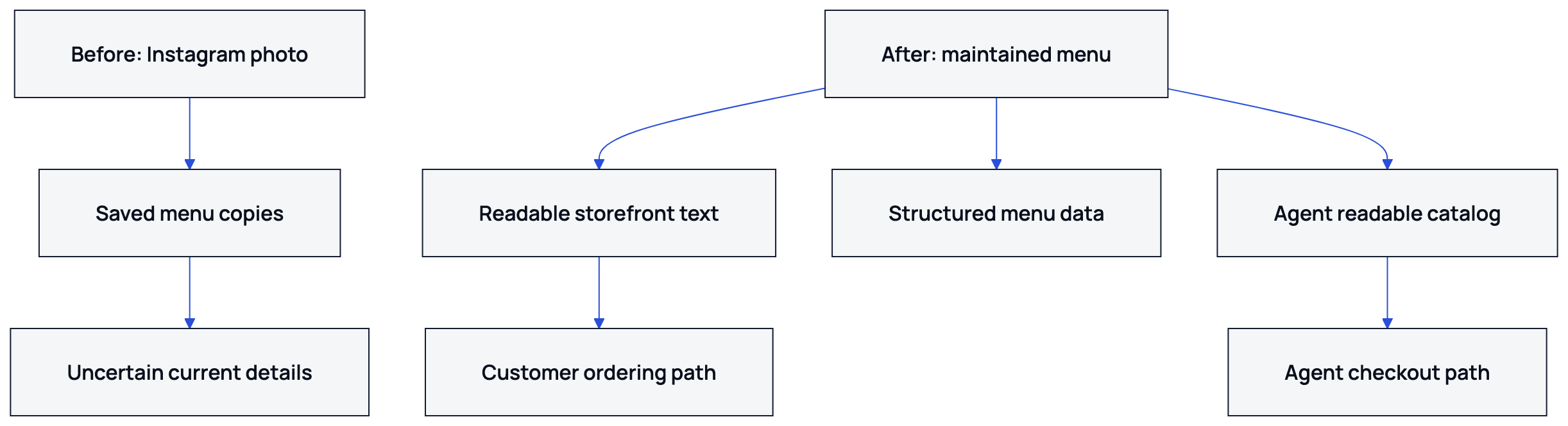
Nexara generates the branded storefront from the restaurant's menu and supports channel-specific menus. Its agent-readable catalog carries item identities, option groups, actual availability and prices in fils. A Jordanian dinar contains 1,000 fils, so the currency unit must stay explicit wherever prices are read. Read one menu across every channel for the wider menu-management approach.
How does Nexara turn a readable menu into an agent order?
An AI assistant can read the live menu, including current prices, modifier groups and availability. It builds the requested basket and gets a server-priced delivery quote using the customer's address. Nexara prices delivery like the storefront.
An anonymous agent verifies the customer's Jordanian phone by SMS code, while a trusted platform completes with a key. The assistant then places a cash-on-delivery delivery order or a pickup order paid at the counter. It enters the kitchen queue, prints in the kitchen, appears on the order board with an AI agent badge and can be followed through its tracking link. Agent ordering is built into every Nexara restaurant storefront for agents that speak ACP (2026-04-17), UCP or MCP. The Nexara agent ordering page describes the flow.
What should you check before publishing your menu?
Start with the public page a customer can open without signing in. Copy an item name and its price into a plain text note. This checks that the information exists as text before reviewing structured data and checkout.
- Write a clear entity sentence naming your restaurant, cuisine, neighbourhood and city.
- Check Arabic and English item names against the dishes your kitchen actually prepares.
- Review required modifiers and optional charges, then compare the basket total with the published menu.
- Check availability and opening hours separately for each branch, including holiday exceptions.
- Keep the website, Google Business Profile and social profiles consistent. Maintain genuine reviews and a phone that someone answers.
- Check the full customer ordering path, including pickup selection or delivery pricing, before sharing the link.
Assign menu maintenance to a named person in the branch or operations team. For the storefront setup itself, see the restaurant ordering website guide for Jordan. The current rates and activation steps are on nexaratech.io.
What to remember
- Put current Arabic and English item names, prices and descriptions in selectable page text.
- List every required modifier and optional charge so the basket can be priced correctly.
- Set availability and opening hours per branch, including exceptions customers need to check.
- Use Nexara's storefront structured data and agent-readable catalog alongside a tested pickup or delivery path.
Questions people ask
Can an AI assistant read my Instagram menu photo?
Some assistants can extract text from images. Publish a text menu as the maintained source so prices, options and branch details can be checked without interpreting a photograph.
What does menu structured data mean for a restaurant?
It means labelling menu information so software can identify dishes and their details. Schema.org provides Restaurant, Menu and MenuItem types for describing the business and its food.
Do I need both Arabic and English item names?
Both help customers who search or order in either language. Keep them attached to the same dish, with matching descriptions and modifier meanings.
Should an AI-readable menu include opening hours?
Publish branch hours alongside the menu and ordering information. Identify local time and holiday exceptions so a reader can check whether the relevant branch is open.
Does schema.org Menu make an assistant recommend my restaurant?
Structured data helps software interpret the menu, but recommendation decisions belong to the assistant's platform. Accurate business details, a maintained Google profile and genuine reviews remain useful preparation.
How do agents pay for an order from my restaurant?
Payment is cash on delivery, or pay at the counter for pickup.